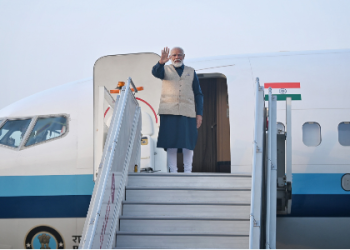
New Delhi, September 11, 2026 — As India rolls out the red carpet for the 18th BRICS Summit this weekend, one line keeps resurfacing in briefings, interviews and official statements: BRICS is “non-Western,” not “anti-West.” The phrase, first popularised by Prime Minister Narendra Modi and later echoed by Russian President Vladimir Putin, has become something of an unofficial tagline for the bloc as it tries to shake off years of being cast as an anti-American, anti-NATO club.

The distinction matters. Over the past two years, Western commentators have often framed BRICS’s growth — particularly its expansion to include Egypt, Ethiopia, Iran, Saudi Arabia and the UAE — as a deliberate counterweight to the G7 and the dollar-led financial order. Putin himself has pushed back on that reading, telling foreign journalists ahead of previous summits that BRICS “was never meant to be against anyone,” crediting Modi’s framing directly.

Why the framing matters now
With Xi Jinping and Putin both expected in New Delhi this weekend, India finds itself walking a careful line. As BRICS chair for the past year, New Delhi has leaned into the “non-West, not anti-West” language partly out of necessity: India maintains deep trade and defence ties with the United States even as it deepens cooperation with China and Russia through BRICS. Framing the bloc as an inclusive platform for the Global South — rather than an ideological bloc against the West — lets India have it both ways.
A bigger tent, a softer edge
The 18th Summit’s theme, “Building for Resilience, Innovation, Cooperation and Sustainability,” reflects this same instinct: technical, developmental language over confrontational rhetoric. Officials point to more than 350 working-group meetings held under India’s chairship this year — on trade, health, AI governance and disaster resilience — as evidence that BRICS’s real work is cooperative, not oppositional.
Still, sceptics note that the bloc’s growing interest in de-dollarisation and alternative payment systems tells its own story. Whether “non-West, not anti-West” holds up as more members join — and as global fault lines harden — may be the real test of this summit.
The expansion complicates the story
The bloc’s growth has made the “non-West, not anti-West” line harder to defend uniformly. What began as an informal grouping coined by Goldman Sachs for marketing purposes has, over two decades, evolved into a community of influential non-Western states, built around a single unifying idea: creating space for interaction that bypasses Western institutions altogether. Analysts note that while an overtly anti-Western stance is unlikely to dominate the bloc’s agenda, member states are nonetheless eager for alternatives to US- and EU-led financial and political mechanisms. This is part of why hosts have increasingly framed BRICS summits around Global South solidarity and inclusive governance rather than direct rivalry with the G7 — a deliberate move to counter Western narratives that paint the bloc as adversarial.
Still, sceptics note that the bloc’s growing interest in de-dollarisation and alternative payment systems tells its own story. Whether “non-West, not anti-West” holds up as more members join — and as global fault lines harden — may be the real test of this summit.
#BRICS2026 #BRICS #BRICSIndia2026 #India #GlobalSouth #Geopolitics #GlobalDiplomacy #InternationalRelations #StrategicAutonomy #WorldOrder #MultipolarWorld #Diplomacy #IndiaGlobal #EmergingWorldOrder #GlobalLeadership #NewWorldOrder #InternationalAffairs #BRICSSummit #IndiaBRICSChairship #BharatMandapam