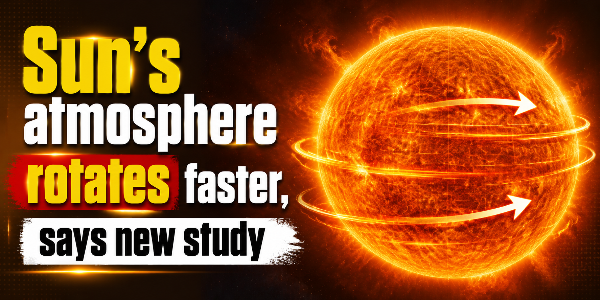
The atmosphere whirling around the Sun spins at a much faster rate than the visible surface of the Sun and the rotation speed increase with height above the Sun’s surface, according to a new study that challenges the expectations of classical physics.

Beyond improving our understanding of the Sun, these findings will help refine models of solar activity and space weather, which can affect satellites, communication systems, navigation networks, and power infrastructure on Earth.
For centuries, our culture has revered the Sun as Surya Dev, a symbol of life and energy. Yet, modern science continues to reveal that the Sun is far more complex than it appears. Like Earth, the Sun has an atmosphere, but scientists have long wondered how this vast atmosphere behaves as the Sun rotates.
Imagine an ice skater rotating at one point in the ice rink. When the skater pulls their arms close to their body, they spin faster, and when they stretch their arms outward, they slow down. This behaviour follows a fundamental law of physics called the conservation of angular momentum. Earth’s atmosphere generally follows this rule.
However, a new study by researchers from Aryabhatta Research Institute of Observational Sciences (ARIES), an autonomous institute under Department of Science and Technology (DST), Udaipur Solar Observatory (USO), Physical Research Laboratory (PRL), and Ahmednagar College found that Sun is not a stickler to this rule.
Using observations from the Nobeyama Radioheliograph in Japan, the team discovered that the Sun’s atmosphere rotates faster than its visible surface, breaking the rules of classical physics.