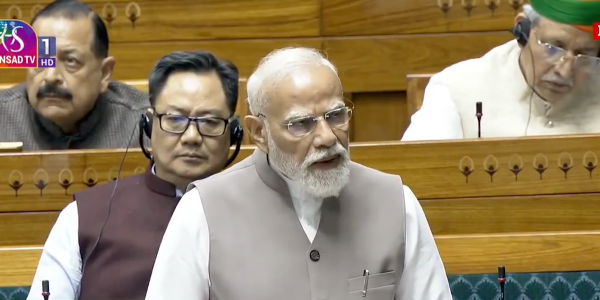
Prime Minister Narendra Modi today addressed the Lok Sabha on the ongoing conflict in West Asia and the wide-ranging challenges it has posed for India. Noting that the crisis has now persisted for over three weeks, with deeply adverse consequences for the global economy and human lives, the Prime Minister underscored the urgency of resolution. Highlighting the gravity of the situation, PM Modi remarked, “The whole world is urging all parties for the earliest possible resolution of this crisis.”

Elaborating on the nature of the challenges confronting India, the Prime Minister pointed out that the war has created unprecedented economic, national security, and humanitarian pressures. He noted that India has extensive trade relations with the warring and war-affected countries, that the conflict zone straddles critical trade routes, and that a large share of India’s crude oil and gas needs is met by this very region. Drawing attention to the nearly one crore Indians who live and work in Gulf countries, as well as the significant number of Indian crew members aboard commercial ships in those waters, the Prime Minister asserted, “India’s concerns are naturally greater, and therefore it is essential that a united and unanimous voice goes out to the world from India’s Parliament on this crisis.”
Outlining the government’s swift response to safeguard Indian nationals, the Prime Minister informed the House that every Indian in the affected countries has been provided necessary assistance since the war broke out. Stating that he has personally spoken, in two rounds, with the heads of state of most of the West Asian countries, all of whom have given full assurance regarding the safety of Indians, PM Modi remarked, “Those who are injured are being ensured better medical treatment, and in such difficult circumstances, necessary assistance is being provided to the bereaved families.”
The Prime Minister further detailed the consular and institutional support framework activated for Indians abroad. He noted that all Indian missions in the affected countries are continuously providing help, issuing regular advisories, and that 24/7 control rooms and emergency helplines have been established both in India and in other affected countries. Underlining the proactive outreach, PM Modi stated, “Through these mechanisms, prompt information is being provided to all those affected , whether they are Indian workers or tourists.”
Highlighting the scale of the evacuation effort, the Prime Minister informed the House that more than 3,75,000 Indians have safely returned to India since the war began, including approximately 1,000 Indians from Iran alone, of whom over 700 are young medical students. He also noted that the CBSE has cancelled the scheduled Class 10th and 12th examinations in Indian schools in the Gulf countries and is taking steps to ensure continuity of education. Summing up the government’s approach, Shri Modi asserted, “The government is sensitive, vigilant, and ready to provide every assistance.”
Addressing the critical question of energy supply, the Prime Minister acknowledged that large quantities of crude oil, gas, fertilizers, and other essentials reach India through the Strait of Hormuz, and that shipping through the Strait has become highly challenging since the war. Stressing that the government’s focus has been on protecting ordinary families from hardship, and noting measures such as prioritizing domestic use of LPG and boosting its domestic production, PM Modi remarked, “Continuous work has been done to ensure that the supply of petrol and diesel continues smoothly across the entire country.”