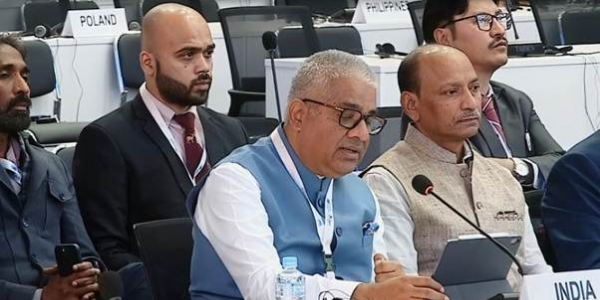
Union Minister for Environment, Forest and Climate Change, Bhupender Yadav, today called for a fundamental shift in the global approach to drought – from reactive relief to proactive, technology-enabled resilience. Addressing the Ministerial Dialogue on ‘Accelerating Drought Resilience’, at the 17th Conference of Parties (CoP17) of the UN Convention to Combat Desertification (UNCCD), in Ulaanbaatar (Mongolia), the Minister said drought is “no longer an occasional event, but a defining development challenge”, affecting water security, food systems, biodiversity and economic stability.

Mr Yadav highlighted India’s coordinated, multi-institutional approach integrating early warning, mitigation, relief and community resilience. Rainfall monitoring and satellite-based drought assessments trigger preparedness at the inter-ministerial and State levels, ensuring that a dry spell does not escalate into a crisis. Emphasising the critical link between land and water, he stated, “restore the forest, before the flow”, underscoring India’s focus on catchment and riverscape forestry to reduce erosion, improve water retention and recharge groundwater. River rejuvenation and revival of traditional water bodies further strengthen water security and rural drought resilience.
The Minister highlighted that community-led restoration of springs and recharge zones in India’s hills, while in the plains, a pan-India watershed programme addresses degraded rainfed lands through a ridge-to-valley approach, supported by community institutions and convergence with rural employment programmes. At the household level, drinking water programmes seek to ensure reliable supplies during periods of stress, with assured service levels, local quality testing and prioritisation of vulnerable areas. He also highlighted crop insurance that protects farmers against drought and other non-preventable losses across the crop cycle, combining subsidised premiums with technology-driven assessment for faster and transparent claim settlement. The Minister stressed that community ownership, capacity building and livelihood diversification are central to the transition from reactive relief to proactive, technology-enabled resilience.