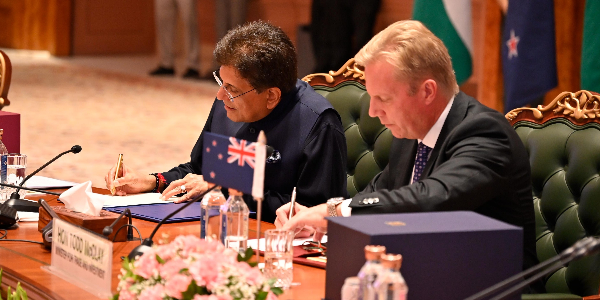
India and New Zealand today signed the India- New Zealand Free Trade Agreement (IN- NZ FTA) at Bharat Mandapam, New Delhi, under the vision and leadership of Hon’ble Prime Minister Narendra Modi to strengthen India’s global economic partnerships. The Agreement was signed by Union Minister of Commerce and Industry Piyush Goyal and New Zealand’s Minister for Trade and Investment Hon. Todd McClay.

The signing ceremony brought together businesses and industry leaders from both countries, with Trade and Investment Minister Todd McClay leading a cross-party delegation of Members of Parliament and over 30 New Zealand businesses.
The signing of the India–New Zealand Free Trade Agreement marks a new and significant chapter in the bilateral relationship, reflecting shared ambition, deepening engagement, and a commitment to mutually beneficial growth said Mr. McClay.
In a message on the signing of the India–New Zealand Free Trade Agreement, Prime Minister of New Zealand Mr. Christopher Luxon termed it a historic milestone, noting that the deal unlocks major opportunities for trade, investment, and innovation for both countries. He highlighted that it will expand market access, support export growth, and enable collaboration in areas like agriculture, while also reinforcing a shared commitment to stable, rules-based trade and deeper people-to-people ties.
Speaking on the occasion, Mr. McClay, noted that the agreement is a “once-in-a-generation” opportunity that will create new avenues for exporters, generate employment, and unlock significant economic potential. It is expected to not only strengthen existing business ties but also accelerate the development of new partnerships, enhancing overall economic engagement between the two countries.
Highlighting the strong participation from New Zealand, he informed that over 40 representatives, including exporters, sector leaders, and business stakeholders, travelled to India to witness the occasion, underlining the importance attached to the agreement.
The agreement is expected to facilitate increased trade and investment flows by improving market access, reducing barriers, and establishing clear and predictable rules. It will support businesses of all sizes, including small and medium enterprises, ensuring wider distribution of the benefits of trade.