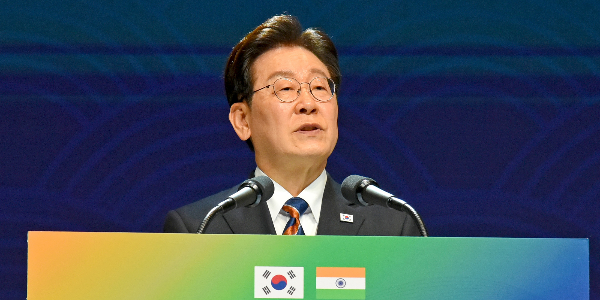
President of the Republic of Korea (ROK), H.E. Lee Jae Myung, today said that India, as the world’s fourth-largest economy and home to 1.4 billion people, stands as a key pillar of the global economy.

Addressing the India–Korea Business Forum in New Delhi, he noted that there is significant scope to further expand business and trade, adding that bilateral trade has considerable room for growth and, with sustained efforts, is expected to double alongside ongoing negotiations on the Comprehensive Economic Partnership Agreement.
He emphasized the need to prepare high-tech industries for the future through collaboration and by leveraging India’s strengths in artificial intelligence. He further stated that cooperation in the shipping sector will be strengthened.
The President also underlined the importance of moving beyond economic cooperation to build strong people-to-people trust between the two countries.
Union Minister of Commerce and Industry Piyush Goyal while addressing the opening session of the India–Korea Business Forum highlighted the signing of the Memorandum of Understanding (MoU) on the India–Korea Industrial Cooperation Committee, comprising four working groups on trade, industry, strategic resources, and clean energy, as a landmark step towards strengthening bilateral economic engagement. A total of 16 MoUs were signed today at India Korea Business Forum.
Goyal further informed that Prime Minister Shri Narendra Modi and President Mr Lee Jae Myung have discussed the establishment of a large industrial township—a Korea-specific enclave in India with plug-and-play infrastructure to encourage greater investments and facilitate the entry of more Korean companies into the Indian market. He noted that this initiative will help Korean companies leverage India’s large domestic demand as well as its preferential access to nearly two-thirds of global GDP, enabled through nine Free Trade Agreements concluded over the past three and a half years with 38 developed economies.
Goyal said that India and the Republic of Korea have been tasked by their leadership to double bilateral trade from the current USD 27 billion to USD 54 billion by 2030, requiring an annual growth rate of nearly 18%. He added that this target does not fully capture the true potential of the partnership and called for efforts to unlock the next phase of economic cooperation.
The Minister stated that both countries have agreed to work on a fast-track, mission-mode approach to upgrade the Comprehensive Economic Partnership Agreement (CEPA), including addressing non-tariff barriers, easing rules of origin, expanding market access, and facilitating greater ease of doing business to achieve a more balanced economic partnership.