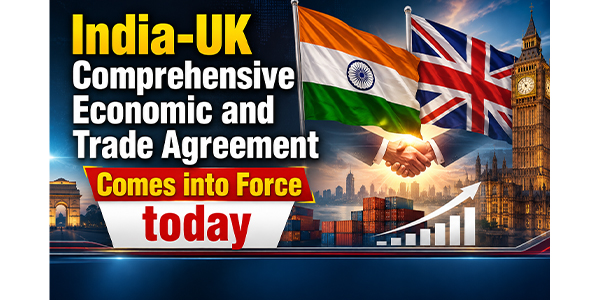
The Comprehensive Economic and Trade Agreement (CETA) between India and the United Kingdom came into force from today. Simultaneously, the Agreement on Social Security, also referred to as the Double Contribution Convention (DCC), also came into effect, which reinforcing the mobility and competitiveness of Indian professionals in the United Kingdom.

The landmark deal grants Indian exports zero-duty access to 99 per cent of tariff lines in the UK market. It reflects the shared commitment of India and the United Kingdom to deepen their strategic partnership and deliver prosperity for their people. Briefing the media in New Delhi, Commerce Secretary Rajesh Agrawal has described the India-UK Comprehensive Economic and Trade Agreement as a defining milestone in India’s trade journey, saying it establishes a future-oriented economic partnership between two major economies. Briefing the media in New Delhi yesterday, he said the agreement will mark the beginning of a new phase in bilateral trade and investment relations between India and the United Kingdom.
Mr Agrawal said the agreement is among India’s most comprehensive trade pacts, offering broad sectoral coverage while reducing tariff and non-tariff barriers. Highlighting the Double Contribution Convention (DCC), Mr Agrawal said the arrangement will benefit Indian professionals and their employers by exempting eligible workers on temporary assignments in the UK from paying social security contributions there for the specified period. Our correspondent reports that the implementation of the India-UK CETA and DCC marks a major step in India’s journey towards becoming a globally integrated, resilient and competitive economy.
This agreement has been designed as a people-centric agreement that delivers benefits across society. The simultaneous enforcement of the CETA and the DCC will open up significant new opportunities for India’s exports. Indian exporters will benefit from the complete elimination of UK tariffs across several key sectors. Tariffs of up to 70% on processed food products, over 21% on marine products, around 18% on engineering goods and auto components, up to 16% on leather and footwear products and around 12% on textiles and clothing will be reduced to zero.
This will significantly enhance the competitiveness of Indian exports in the UK market, generate new opportunities for farmers, fishermen, MSMEs and manufacturers, and strengthen India’s integration into global value chains. Under the agreement, India has protected its sensitive sectors, including dairy products, cereals, millets, edible oils, oilseeds, apples and several vegetable products.