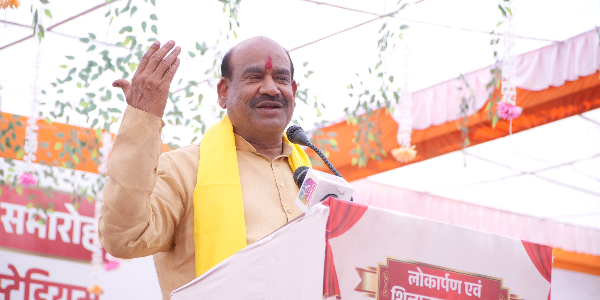
Lok Sabha Speaker Om Birla today called for a coordinated and proactive approach involving all stakeholders—government institutions, Panchayati Raj Institutions, Urban Local Bodies, Van Panchayats, and citizens—to ensure sustainable development and ecological balance. He emphasized that empowering local communities and respecting traditional knowledge systems are essential for long-term environmental sustainability and national progress.

Addressing representatives of Van Panchayats, elected members of the three-tier Panchayati Raj system, and Urban Local Bodies at Dr. Raghunandan Singh Tolia Administrative Academy, Nainital, Birla noted that Uttarakhand’s Van Panchayats have emerged as a successful model of community-based forest management. He said that these institutions are contributing not only to conservation and regeneration of forests but also to livelihood generation and the vision of an Atmanirbhar Bharat.
During the programme, he also interacted directly with the representatives and listened to their experiences, challenges, and suggestions.
Describing Van Panchayats as “the strongest link in India’s democratic framework,” Shri Birla underlined that grassroots institutions play a vital role in conservation and governance. He remarked that interacting with Van Panchayats is akin to engaging with the most robust pillar of democracy and observed that the experience of these local bodies is no less significant than that of institutions at the national level.
Highlighting the intrinsic relationship between Jal (water), Jangal (forests), and Jameen (land), Birla said these natural resources form the foundation of ecological balance and human sustenance. He stressed that their conservation is not merely an environmental necessity but a collective responsibility that requires active participation at the grassroots level.
Lauding Uttarakhand’s rich cultural and environmental heritage, Birla said the State represents a living example of harmonious coexistence between humans and nature. He acknowledged the invaluable contributions of local communities in protecting forests and biodiversity, noting that traditions such as reverence for water and trees continue to guide sustainable practices.